Posts

Update 2: The Final Project

Over the weekend I played with both Prezi and ARCGIS to determine which platform would be best for my story map. Long story short, I'll be using ARCGIS. In Prezi I’d need many more images within the presentation itself to provide the same level of detail already built into ARCGIS. Within my story map I'll be using the ARCGIS journal builder to display information on each installation site. Using the Virginia WWI and WWII Commemoration Commission  and the Library of Virginia’s “Guide to the Virginia War History Commission, Records, 1915-1931”  websites, I was able to identify the installations operating or founded between 1914 and 1918, 20 in all: Northern Virginia: Camp A.A. Humphreys (now Belvoir)  Front Royal Remount Station Camp Bally Camp Lee (now Fort Lee) Coastal Virginia: Camp Eustis on Mulberry Island near Newport News (combined with Langley in 2010) Camp Alexander Camp Casino (Newport News) Camp Hill Camp Morrison Camp Stuart Fort M...

Unit 8: Digitizing and Sourcing Images and Text (and Video)

Image
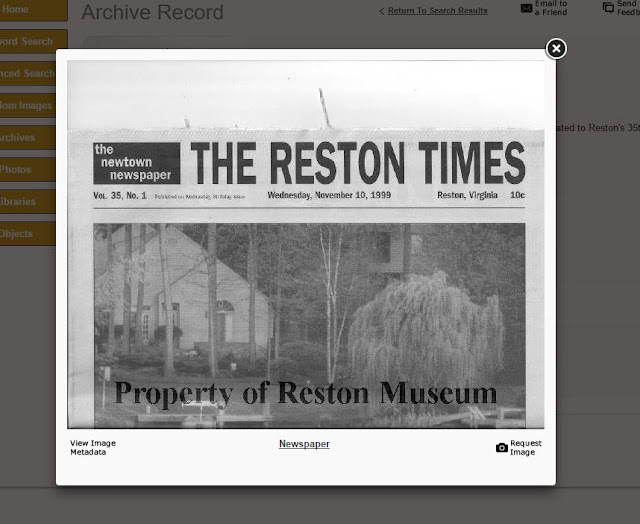
When looking for digital sources for class and personal projects, I often go to YouTube for video and Flickr or Creative Commons for photos. I also use personal photographs for projects as well, because I find it often easier to just take a picture of something and email it to myself.  A great example of that would be museum artifacts. Throughout the certificate program I’ve visited and critiqued museums. Often my in-class presentations will be a combination of images pulled from the museum’s website in conjunction with my own photographs taken via iPhone. These local museums may not have high resolution images on their websites of the artifacts or foibles I’d like to highlight and it can be easier to get physically closer to the artifact for clarity, then take a picture.  A personal archiving adventure I’ve dabbled in digital archiving with my mom, transferring photos and home videos into DVDs or digital files. My mother’s side of the family has amassed an impressive amou...

Unit 7: Copyright and the Web

Image
Reading Rosenzweig's chapter on copyright helped frame the world of copyright law in a succinct and meaningful way. I see now that there are grey areas to copyright, especially when the idea of fair use is thrown into the mix. As some of my former classmates may know, I have a general interest in the law and spent a year in law school before deciding the study of law was more a hobby than a profession, so I found this information very interesting. I also found the video, A Fair(y) Use Tale , entertaining and informative. Having read Rosenzweig's chapter first, I still balked at the use of Disney's opening in the video, even with the disclaimer. Having grown up in the late 80's and 90s, I remember seeing the FBI warning before movies (on VHS) and knowing that it was illegal to copy a movie and resell it. Later in life, however, I've only been exposed to copyright concerns from an academic perspective; I don't deal commercially with copyright issues at work. D...

Update on the Final Project

Image
For my final project, I'd like to create a story map. Initially I was floundering on what exactly I would represent, but I've since latched on to one of Professor Evans' ideas, a map of WWI military installations in Virginia. As a military brat, I have a special affinity for military installations, having lived on them the first 18 years of my life. I've done some research into the actual sites of the installations ( here and here seem like good places to start), but have spent more time deciding which platform to use to create my story map. During college I became adept at using Prezi, and consider that platform a contender for this project. In the below video you can see some of the ways in which Prezi can be used to create a story map -- and it has the added ability to make things look visually complex in layers of text and graphics. Of course I've also been looking into what ArcGIS can offer -- the gallery is a particularly useful place to start. The ...

Unit 5: Building a Web Culture (Style Design Standards and HTML 5)

Image
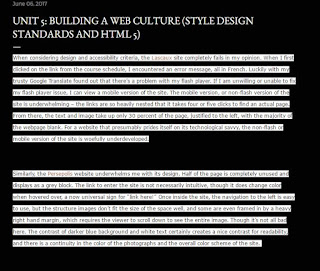
The chapters out of this unit were especially helpful for editing the design of my blog. In the past several units I've struggled with editing the text in a post so that it will show up as intended. Often while writing in Blogger I'll have to "preview" a post multiple times to create a successful post. Using the "compose" functionality of Blogger can be more trouble than it's worth, so I've tried switching between the HTML and compose functions with some success. Once I've completed a post, I then have to change the font to white and highlight to black to create the correct contrast in the blog. If not, the results are less than satisfactory:  Initially I chose the black background and white text color scheme for greater contrast, but in the process I limited my creative options. To update my blog for this unit, I've decided to: Change the color theme to remove the need to edit the color of text Include color images as...

Unit 4: The Evolution of the Digital Web

In chronological order from earliest to most recent, I believe the website order should be something like the below:  The Avalon Project American Memory   Dickinson Electronic Archive   Romantic Circles Amiens Cathedral Project Persepolis: A Virtual Reconstruction   Hurricane Digital Memory Bank Hawthorne in Salem The April 16 Archive   In Our Path   Digital Karnak Eye Level Life Outtacontext Oyez   Lascaux Part of the issue of chronologically sorting websites by their overall look -- some of the older looking ones were created more recently! For example, the Avalon Project website lists a copyright of 2008. The website doesn't have some of the main aspects we've come to expect in websites today (clean design, useful navigation, seamless interactivity) because the website was built for a single purpose -- to house transcripts of documents relating to law, history and diplomacy, beginning around 4000 BCE. As was discussed...

Unit 3: The Multi-Talented Blog

In searching on Google for a wide range of history blogs to compare and contrast, I first noticed that the search “history blogs” would get me nowhere. As mentioned in the last reading, there are so many blogs on the internet today that finding a credible authority on a specific topic can take some serious digging. Another issue with the world of blogs – how best to distinguish which are truly active? In searching I’ve found several that I would read, only to find out that they stopped posting abruptly several years ago. Depending on the audience, it is conceivable that a person could stop posting one day if only their mother and next door neighbor’s cat were avid readers. The size of the audience could also dictate the amount of effort an author is willing to put into posts. If the poster isn’t relying on the blog for monetary gain or fame, it would be much easier to pack it up when it got boring. I am interested in a wide range of historical topics, but most often local history ...